Forty: The Age of Becoming?
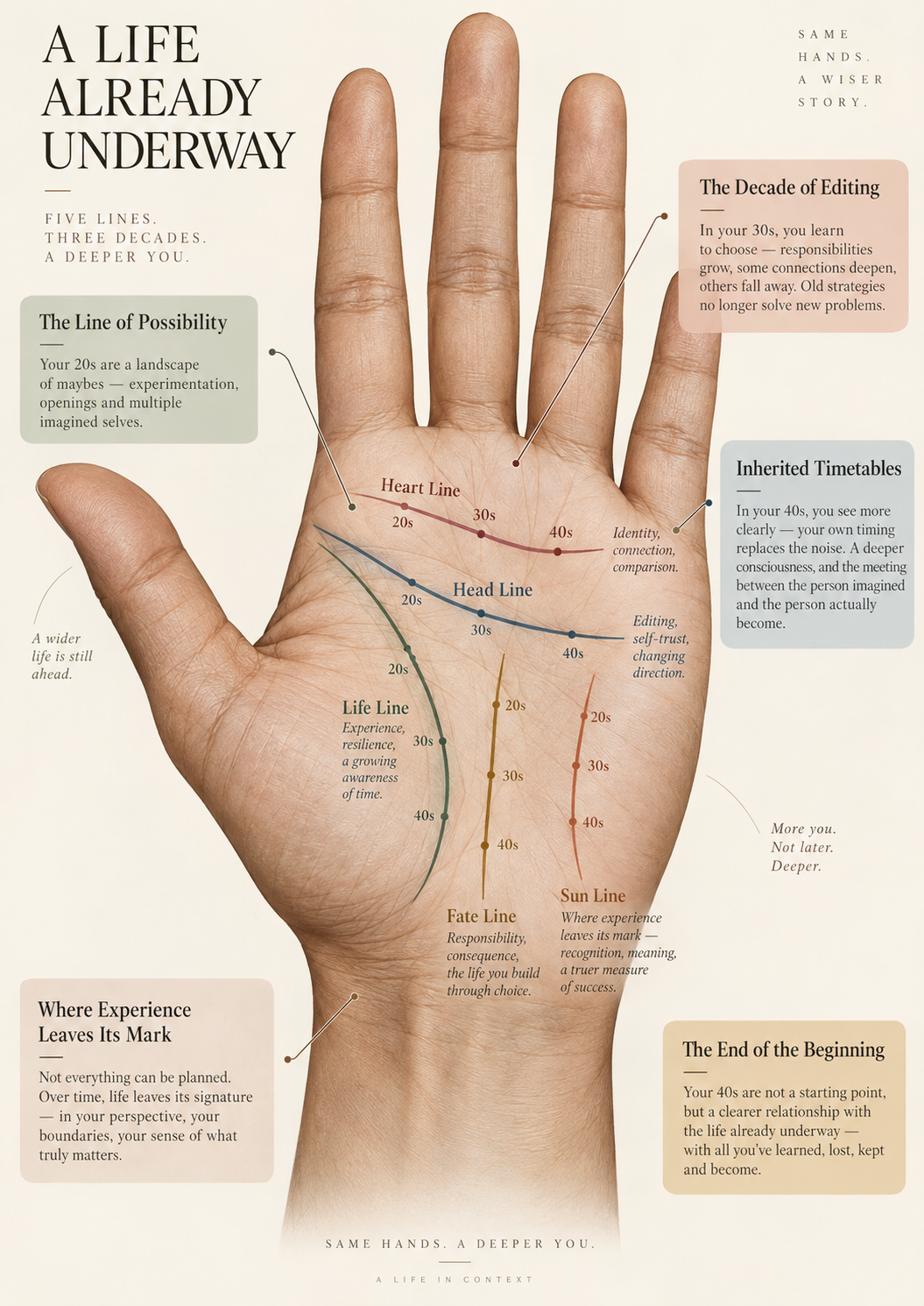
The Life Already Underway
A couple of months ago, I watched a keynote speech about the idea that life begins at forty. I am not forty yet; I am somewhere in the middle of my thirties, but the subject lodged itself in my mind.
I have always been fascinated by age. I often joke that I was born a sixty-year-old woman: temperamentally old before my time, yet apparently ageing rather slowly on the outside. My niece spent years insisting that I looked like a teenager, although recently she finally upgraded me to twenty. Progress.
But my fascination with ageing has never really been about looking young or growing old. It is the psychology of it that interests me: the becoming, the transformation, the strange way experience changes how we see ourselves and the world around us.
What do we know at forty that we could not have known at twenty? And how much of what we associate with a particular age actually comes from age itself?
If life begins at forty, what were the previous thirty-nine years? Preparation? A rehearsal? And why forty? Why not fifty?
So I started asking people in their thirties, forties and fifties what their thirties had actually been like. What had those years taught them? What surprised them? And, for those who had crossed the threshold, did the idea that life begins at forty resonate? I expected different perspectives. I did not expect quite so little agreement.
There is no universal forty
The responses quickly made one thing clear: there is no shared experience of turning forty.
For one man approaching the milestone, forty was almost intimidating. “I’m freaking out,” he told me, half-joking about the grey hairs while hoping something new might begin on the other side.
A woman already in her forties felt almost the opposite. She had built a family, navigated marriage, children and a mortgage, and saw no reason for a before and after. “It’s just another chapter,” she said.
Then there was the fifty-year-old man, who rejected the optimism altogether. To him, forty brought a sharper awareness of retirement, ageing parents, physical change and more consequential decisions.
Three people. Three versions of the same age: a threshold, continuity, a reckoning.
The more responses I collected, the harder it became to talk about forty as though it were one experience. Chronological age tells us remarkably little about where somebody actually is in life.
Perhaps the problem with Life Begins at Forty is not whether the phrase is true or false, but that it asks age to do more explanatory work than it can. What if forty simply gives us a point from which to interpret what we have already accumulated?
What if what matters is not simply how old we are, but what we have lived through, what choices remain and how much agency we feel over what comes next?
That led me to a bigger question: Why do we imagine life has a beginning point at all?
We are aged by more than time
Imagine climbing a hill. For much of the climb, your attention is directed upwards, towards what might still be achieved. Then, somewhere near the summit, your perspective changes. You notice the other side. The landscape has not changed. You have. And the questions change with it.
Earlier in adulthood, we might ask: What might I become? Later: Is this really who I have become?
Nothing dramatic necessarily happens between thirty-nine and forty. There is no switch in the body that activates at midnight. What changes is our relationship with time.
The future feels more measurable. Things we assumed we would do “one day” acquire a deadline: careers we may never have, places we may never live, versions of ourselves that begin to feel further away.
But psychology cannot explain the whole story. If turning forty were simply a natural crisis of ageing, people across cultures and history might experience it similarly. They do not.
Biology matters. Psychology matters. But so does history.
One of the most powerful ideas I encountered while researching this essay was this: We are aged not only by our bodies, but by history.
Forty carries meaning because we inherit ideas about what forty is supposed to look like. Societies create invisible timetables.
Finish your education. Build a career. Find a partner. Marry. Have children. Buy a home. Become financially secure. Become established.
No one formally hands us this timetable, yet somehow we absorb it. Cultural expectations begin to feel like personal desires. We stop asking where the script came from and start wondering why we have failed to follow it. Perhaps what some people experience as a crisis of age is actually a crisis of comparison:
The distance between the life we imagined we would have and the life we actually find ourselves living.
From possibility to position
Perhaps one reason forty carries so much psychological weight is that we do not arrive there empty-handed. We arrive carrying our twenties and thirties with us.
For many of us, our twenties are defined by possibility. Not necessarily ease - they can be precarious and confusing - but possibility still feels expansive. Careers begin. Relationships form. Cities can be changed. Identities are tested. A wrong turn can often be absorbed as experience rather than destiny.
Everyone still seems to be becoming. Who will I be? What kind of work will I do? Who will I love? Where will I live?
Then the thirties arrive, and possibility gradually turns into position. People marry, divorce, have children or change direction. Parents grow older. Mortgages appear. Friendships reorganise around increasingly different lives.
I am still in my thirties, so I cannot tell you what forty feels like from the other side. But the decade is often described as the point when everything finally settles: career, money, relationships, home, family.
Developmental psychologists have called the period roughly between thirty and forty-five established adulthood. It sounds reassuring. Established. Settled. Secure.
Yet researchers have also called it the “rush hour of life”: when careers, finances, relationships, parenthood, housing and family responsibilities collide. That feels closer to what I see. The thirties do not necessarily reveal that we have life figured out. They reveal things about us.
One thirty-five-year-old described the decade as both “a source of pain and joy”: pain from confronting what had shaped him; joy from the self-understanding and liberation that followed.
A thirty-six-year-old had spent much of earlier adulthood fitting herself into a life that looked right from the outside but felt unnatural within. Her thirties became a process of shedding those layers and learning to be herself.
Another woman entered the decade carrying profound loss and responsibility and increasingly felt “behind”. Yet approaching forty brought greater confidence, clearer boundaries and less need to prove herself.
Different lives, but a common thread. The thirties seem to test the identities we spent our earlier adulthood building.
I see it in people questioning careers they once worked desperately to create. Friendships falling away. Relationships deepening or falling apart. The thirties are not simply a decade of building. They can also become a decade of editing.
Experience begins testing the ideas we accumulated about who we were supposed to become. Some survive. Others do not.
And maturity, I am beginning to think, may involve as much subtraction as addition: removing identities that no longer fit, expectations that were never really ours, relationships sustained mostly through obligation, goals pursued because they looked impressive from the outside.
But getting older gives us the opportunity to become different; it does not necessarily make us different.
We can arrive in our thirties facing new problems while still trying to solve them with instincts developed in our teens and twenties. Ways of thinking that once protected us can become limitations; habits that helped us survive uncertainty can become obstacles when life asks something different of us.
There is comfort in what is familiar, even when it no longer works. We can keep approaching relationships, careers and conflict with the same strategies simply because they are the ones we know.
Perhaps part of maturity is recognising when an old solution has reached its limit. The problems of later adulthood can require capacities that earlier life never forced us to develop: different ways of communicating, choosing, letting go, taking responsibility or tolerating uncertainty. Those capacities are rarely learned through comfort; they emerge when the familiar stops working and we are forced to respond differently.
One respondent put it simply: “Wisdom is experience, not age.”
I think he is right. Forty does not deliver wisdom at midnight. The years before it give us experience, and choices we once imagined as isolated begin revealing themselves as connected. Possibility does not disappear. It becomes more consequential.
One older respondent put it starkly: from forty onwards, decisions increasingly began to feel like decisions about “the rest of your life”.
I would not go quite that far. People reinvent themselves at fifty, sixty and beyond. But at twenty-five, changing direction can feel like trying another road. At forty, the road already travelled is longer. There may be a partner, children, financial commitments, a career built over two decades, people who depend on you.
Starting again is still possible. It simply no longer means starting from zero. There is still enough time to change direction, but no longer enough time to pretend every direction remains equally available.
Possibility has not disappeared. It has acquired opportunity cost.
Every choice now sits beside the choices it excludes. Stay, or go. Continue the career, or leave what you spent years building. Choose stability, or risk it for something uncertain. Hold on to the person you have been, or make room for the person you are becoming.
Perhaps this is why forty can feel both liberating and unsettling. The twenties ask what our lives could become. The thirties begin showing us what they are becoming. Somewhere around forty, the question changes: Given where my life has brought me, what do I want to do with what remains possible?
Forty in the age of comparison
There is another complication. We do not evaluate where life has brought us in isolation. We do it while watching where everyone else appears to have arrived.
In our early twenties, most lives still look unfinished. One friend is studying. Another is travelling. Someone has started a graduate job; someone else has no idea what they want to do. People move cities, change careers, move home, start again. Difference can still feel like experimentation. Everyone is becoming.
Then those differences acquire meaning. A job becomes a career. A relationship becomes a marriage. Someone buys a house. Someone has a child. One salary accelerates while another career stalls.
By the thirties, comparison has more material to work with. Lives are producing visible outcomes, and society is very good at ranking them.
Technology has industrialised the process. Previous generations compared themselves too; humans did not invent envy alongside Instagram. But the comparison pool was smaller. Today, before breakfast, LinkedIn can show us who was promoted, Instagram who is travelling, and property websites what people can afford.
Wedding and pregnancy announcements mark still more milestones.
A life becomes increasingly legible as a scoreboard. Salary. Title. House. Relationship. Children. Savings. Body. Travel. Network. Achievements. Followers.
By forty, there is enough evidence to conduct an audit. Who progressed faster? Who accumulated more? Who married? Who bought? Who built? Who became somebody?
The invisible timetable suddenly has data. Yet many of the things that determine whether a life actually feels successful remain almost impossible to measure.
Peace. Integrity. Knowing yourself. The quality of a friendship. Feeling safe with another person. Enjoying your own company. Knowing when enough is enough. Liking the person you have become.
One person mentioned having more money as one pleasure of his thirties. What stayed with me was everything alongside it: less embarrassment, less FOMO, greater peace, clearer ideas about friendship and love, and more enjoyment of his own company.
Perhaps that is the trap. We compare what is visible because visibility makes comparison easy, then begin treating what is measurable as though it must also be what matters. The older I get, the less convinced I am.
I increasingly suspect that some of the most important evidence of a life well lived is precisely the evidence nobody else can see.
The end of the beginning
So, does life begin at forty? For me, there is nothing magical about the number.
What I love about getting older is what the years have given me: greater confidence, self-trust and clarity. Every year teaches me something I could not have learned simply by being told. I have never wished to return to my younger self. I think about her often, but not with regret. I am grateful to her.
She was brave. Steadfast. Resilient. Often anxious, but remarkably good at turning that anxiety into information - into intuition, preparation and, sometimes, courage.
She brought me here. I would not go back to change her story. I want to keep moving forward, carrying her spirit while becoming someone she could not yet have imagined.
Perhaps that is why I struggle with the idea that life suddenly begins at forty. Some arrive more certain than ever; others question everything. Some feel free, some trapped. Some fulfilled, while others are only beginning to understand what fulfilment means.
There is no transformation waiting automatically on the other side of thirty-nine. But I keep returning to something one of the people I spoke to said. Forty, he told me, is not the beginning of the end.
It is: “the end of the beginning.”
The more I think about it, the more I like that description. By forty, enough life has happened for patterns to become visible. We have made choices and lived with their consequences. Pursued things we wanted and discovered whether they were worth wanting. Loved people. Lost people. Outgrown people. Changed our minds. Surprised ourselves. Succeeded at things that did not make us as happy as expected. Failed at things that taught us more than success might have. Somewhere along the way, the person we once imagined becoming meets the person we actually became.
Perhaps that meeting is the real significance of forty. Not a beginning. Not an ending. A moment of perspective: a chance to see more clearly what has shaped us, what remains possible, and what we want to do with it.
Maybe life does not begin at forty.
“Maybe what begins is a more conscious relationship with the life already underway.”
