How Today’s Economy Is Reshaping Gender Dynamics
A deeper look at gender dynamics
I’ve wanted to write about modern gender dynamics for some time. This feels like the right moment, building on my earlier reflections on education, economic scripts, and the importance of optionality and positioning.
Public discourse on gender dynamics has become increasingly polarised. As a result, the underlying structural shifts are often oversimplified or missed entirely. Many of today’s tensions are not random or purely cultural, they are deeply connected to how the modern economy is evolving. We are living through this transition in real time, without a clear blueprint or settled script.
What is often described as a single “change in gender dynamics” is, in reality, two overlapping forces.
The first is a long-term shift ~accelerating with Millennials~ toward greater equality and less rigid roles: women entering the workforce at scale, expectations of shared responsibility, and a gradual loosening of traditional norms.
Layered on top is a more recent pattern, particularly visible among Gen Z, of fragmentation; where men and women are forming increasingly distinct views on identity, relationships, and expectations, often shaped by online environments.
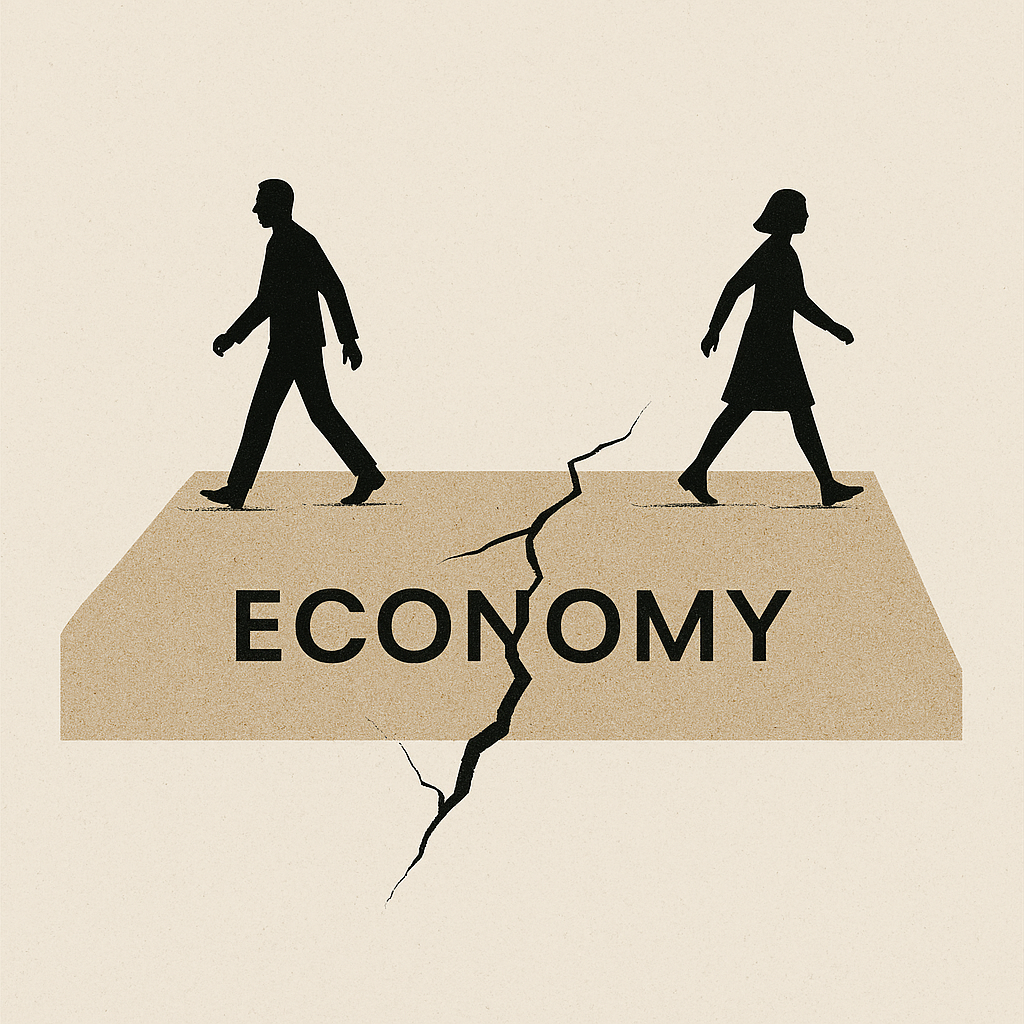
The result is not a smooth transition, but a paradox: progress and divergence unfolding at the same time.
There is a growing sense that something fundamental has shifted. The traditional scripts that once guided men and women have been eroding for years, but we are now firmly in the middle of that transition; an uncharted phase where expectations lag behind reality.
Markers of adulthood: stable careers, home ownership, financial security, and clearly defined social roles, no longer arrive in a predictable sequence. For many, they do not arrive at all. The result is not just economic pressure, but psychological disorientation.
We can already see this in tangible ways: women are outpacing men in educational attainment across many developed economies, while young men’s earnings and workforce participation have become more volatile. At the same time, traditional milestones like home ownership and family formation are being delayed or redefined.
Increasingly, that disorientation appears gendered. Men and women are not experiencing, or interpreting, the disruption in the same way.
At the heart of this divide is a simple reality: the modern economy has evolved faster than the identities built to navigate it.
The Collapse Of The Old Model
For much of the 20th century, the system was stable. Men pursued linear careers, steadily increasing earnings and status. Their identity was tightly coupled to a singular function: to provide.
Women, by contrast, were often economically constrained, but this produced a different kind of adaptation. Their identities were rarely organised around a single axis. Instead, they balanced multiple roles while navigating shifting expectations.
That difference matters.
Women are often socialised earlier into managing variability, biologically, socially, and practically. Over time, this can cultivate a more adaptive orientation toward planning and engagement with the world.
Men, in contrast, were oriented toward consistency: pick a path, commit, advance. This worked in an economy that rewarded stability. It is less suited to one defined by volatility.
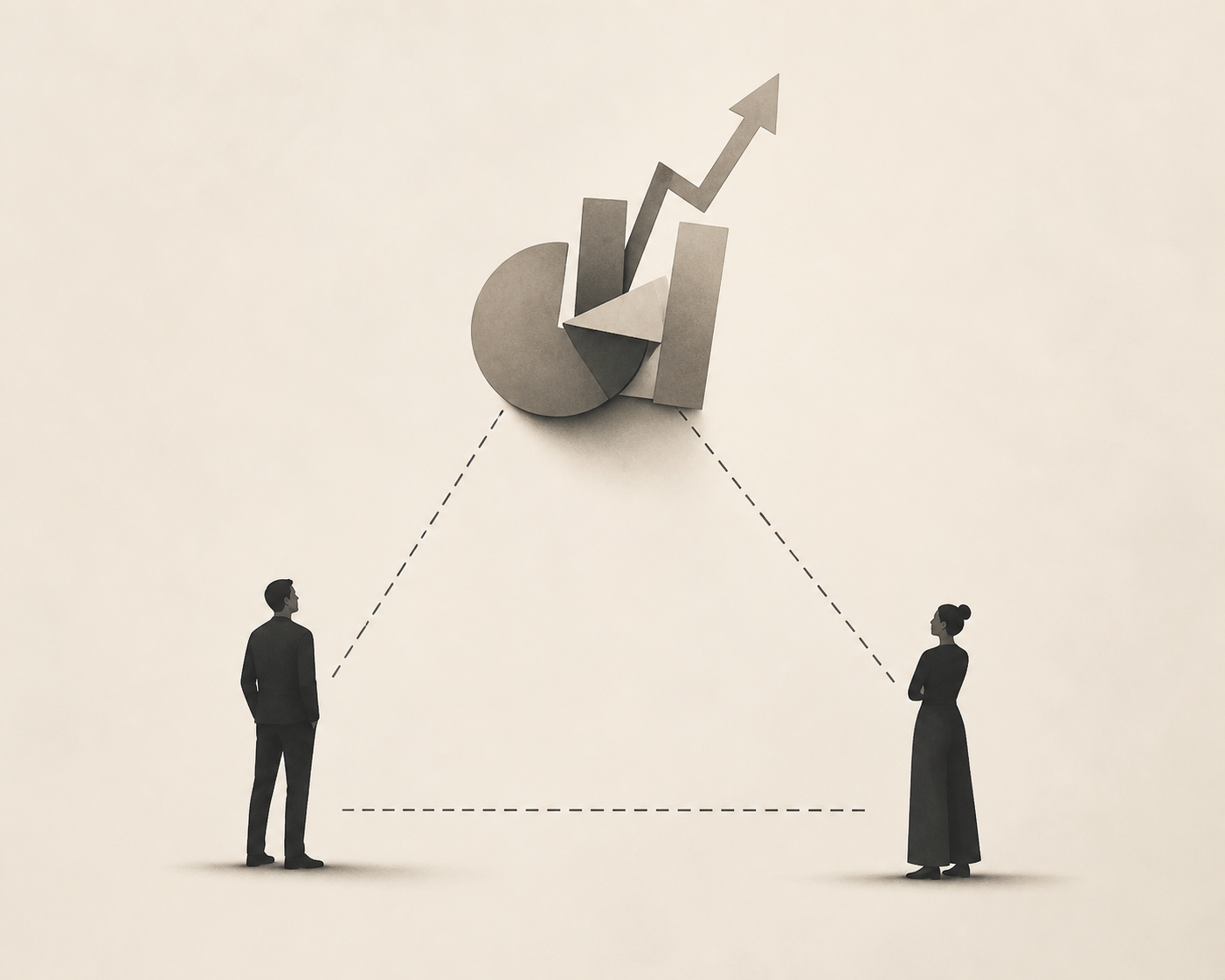
The previous arrangement was not equitable, but it was coherent. And coherence, more than fairness, is what made it function. That script has now fractured.
The modern economy is defined by instability: precarious employment, rising living costs, housing inaccessibility, and the erosion of predictable career ladders. At the same time, women have made significant gains in education and workforce participation.
What we are witnessing is not just economic change, but a mismatch between the traits the old system rewarded and those the current system demands.
Adaptability is rising in value. Linear progression is not. The result is a quiet but profound restructuring of gender, work, and value.
The previous arrangement was not equitable, but it was coherent.
Sociological Shifts: Education, Work, And Relationships
The most visible driver of these changes is the transformation of education and the labour market.
Women now outperform men across many educational metrics, leading to greater representation in professional sectors. Meanwhile, the decline of traditionally male-dominated industries has removed many pathways that once offered stable employment without advanced degrees.
The modern economy rewards a different set of skills: adaptability, communication, cognitive flexibility. These are not inherently gendered, but they are shaped by environment. Schools, universities, and peer networks play a significant role in developing them.
This is where effects compound. If women are, on average, outperforming men in education while also being more consistently socialised toward adaptability, they may enter the modern economy with greater alignment.
Men from less advantaged backgrounds can find themselves doubly misaligned, lacking both credentials and the soft skills now being rewarded.
This is not just an education gap, it is an alignment gap.
This shift does not stay contained within the workplace. It extends directly into relationships.
Historically, women’s preference for partners of equal or higher socioeconomic status was rooted in necessity. When access to resources was limited, partnering “up” was a rational strategy for stability. That logic became embedded culturally and psychologically. Today, conditions have changed, but preferences have not fully recalibrated.
As women move up educationally and economically, partner selection is shaped not only by income, but by intellectual and educational parity.
Men, in aggregate, have historically applied broader criteria. Because their role was defined more by provision, they were more likely to partner across socioeconomic lines.
The result is not simply a smaller pool, but a structurally imbalanced one.
Consider a high-achieving woman in her early 30s: well-educated, financially independent, and socially accomplished. On paper, she has more options than ever before. In practice, her pool of compatible partners may feel narrower.
Dating below her educational or socioeconomic level is not just a personal choice; it carries social signalling costs, often perceived as “dating down.” At the same time, many men are not socialised to navigate relationships where they are not the primary provider, creating uncertainty around roles and expectations. What appears as abundance on the surface can feel like constraint.
This dynamic becomes particularly visible among Millennials.
As women have gained economic independence, partner expectations have shifted away from financial necessity and toward emotional compatibility, shared responsibility, and mutual support. The friction arises when these expectations meet men who are themselves under economic pressure, or still oriented toward older definitions of provision.
What emerges is not a traditional imbalance, but a mismatch: both partners under strain, but in different ways.
At the same time, men who struggle to meet the provider benchmark may experience a decline in perceived value, externally and internally. When identity has been anchored to provision, its erosion creates a vacuum. What replaces it ~emotional connection and vulnerability~ requires skills not equally emphasised in male socialisation.
For men who do succeed economically, the dynamic is not necessarily simpler. Financial success can expand options, but also complicate trust, raising questions about whether attraction is genuine or tied to the provider role.
The result is tension on both sides.
Women navigate a narrowing and asymmetrical pool of partners. (moral judgement, “what’s wrong with her” “she is asking for too much”)
Men face uncertainty about their role in a system where provision is no longer sufficient. (status-based judgement “he must be undesirable” “ he is failing/ unsuccessful”)
Both get boxed in by different expectations in a pretty reductive way.
Psychological Fault Lines
One of the most profound impacts of this shift is psychological.
Across age groups, there is a growing sense of being “stuck”, of having followed the expected path, yet failing to progress. This is not just frustration. It is a collapse of meaning.
For men, this disruption often cuts to identity. Historically anchored in work and provision, the loss of these markers is not just practical, it is existential. When expected rewards fail to materialise, it can feel like personal failure or a broken social contract.
Consider a man in his earl 40s. He followed the expected path, entered the workforce early, stayed consistent, prioritised stability over reinvention. Now, as living costs rise and his earnings stagnate, the gap between effort and outcome widens. Without having built the flexibility to pivot, change feels less like opportunity and more like starting over. Earlier adaptation in late 20 early 30s can feel iterative. Later adaptation, under pressure feels existential. For many, it is not just the difficulty of change, but the sense that it may be too late.
Compounding this is a reluctance to seek support, shaped by expectations around self-reliance and leadership. In some cases, withdrawal feels easier than exposure.
Women, on average, tend to hold more distributed identities. Career is important, but often integrated with relational and social dimensions. This does not remove hardship but it can make it less singularly defining. For many Millennial women, the defining shift is not just economic pressure, but role expansion.
They were among the first cohorts encouraged to “have it all”: career, independence, and often a disproportionate share of caregiving.
As a result, similar pressures manifest differently: men experience identity ambiguity, women experience recalibration.
The Adaptation Gap
Not everyone responds to these changes in the same way. The key divide is adaptability. Men are, on average, more exposed to it; not because they are less capable, but because they were more heavily optimised for stability. Women, having navigated discontinuity more often, may be better positioned to adapt.
What makes this transition particularly complex is that it is not experienced symmetrically. Both are responding to the same forces, but from different starting points.
The underlying model has changed.
Previously:
Men provided financially
Women supported domestically
Now:
Both are expected to earn
Domestic expectations have not fully equalised
Men have lost the exclusivity of the provider role but have not consistently gained a clear alternative. What emerges is not freedom, but ambiguity.
This is not a zero-sum shift. Rising costs mean dual incomes are no longer optional, they are necessary. Both partners are under pressure. What has replaced the old dynamic is not balance, but compression: not one provider and one dependent - but two earners, both carrying uncertainty, trying to stay afloat.
Long-Term Consequences
The long-term implications are already visible.
As economic and educational asymmetries widen, traditional relationship patterns become harder to sustain. Marriage is delayed, family formation declines, and singlehood becomes more common.
At the same time, a segment of men is disengaging from work, relationships, and social institutions. When the system feels unwinnable, withdrawal can appear more rational than participation.
Women, meanwhile, are not simply benefiting. Economic progress has come with intensified expectations. The dual burden persists, often redistributing pressure rather than removing it.
Beneath these trends lies a deeper transformation: masculinity and femininity are being renegotiated, but the new definitions remain unclear.
What the modern economy ultimately selects for is not gender, but adaptability.
So, What Now?
The reshaping of gender dynamics is not a story of progress or decline, but one of misalignment: between expectations and reality, identity and opportunity, stability and change.
Men and women are both navigating this terrain, but with different tools, histories, and pressures. What appears as a gender divide is, at a deeper level, not a single shift, but overlapping transitions: progress and fragmentation unfolding at the same time.
The old economic model supported clear/fixed scripts. The current one does not.
fixed scripts reduced uncertainty = limited possibility.
Open scripts expand freedom = demand responsibility.